
Water Damage Restoration in Kenosha, Racine, & Waukesha County
Water damage in Southeast Wisconsin doesn't follow a predictable script. In Waukesha County, clay-heavy soil that can't absorb groundwater fast enough sends spring snowmelt straight toward foundations in Brookfield, Muskego, and New Berlin. Along the Root River corridor in Racine, seasonal flooding affects entire neighborhoods. On Kenosha's lakefront, Lake Michigan storm systems drive water intrusion that inland markets never see. And across the region's dense residential base in Franklin and Oak Creek, sump pump failures and appliance failures — a washing machine hose or a dishwasher overflow — create thousands of gallons of damage overnight before anyone wakes up.
911 Restoration of Southeast Wisconsin operates year-round across all three counties — Waukesha, Racine, and Kenosha — with true 24/7 emergency service. Owner Joe Minsky and his IICRC-certified crews carry truck-mounted extraction equipment capable of removing thousands of gallons, thermal imaging cameras for hidden moisture detection behind walls and under floors, and commercial-grade drying systems that document every drying cycle for insurance. From the first call our goal is simple: fast water mitigation to stop the damage spreading, then a complete restoration back to pre-loss condition. Our emergency response time is a 45-minute arrival guarantee, around the clock, every day of the year.
Our Restoration Services
Emergency Water Extraction & Removal
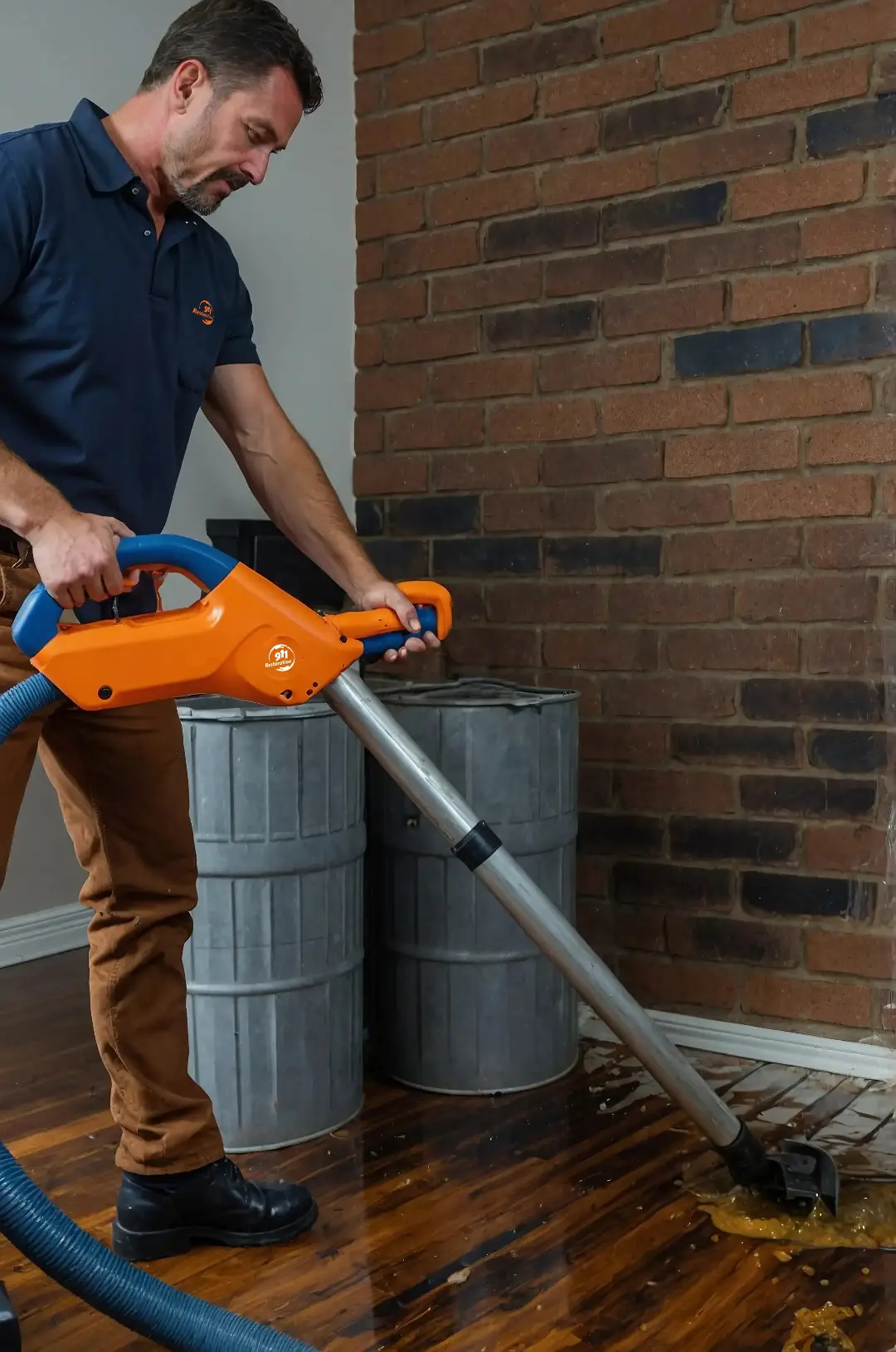
Speed is the variable that determines how much damage water causes. Water that sits for 24 hours begins causing secondary damage — swelling framing, delaminating subfloors, activating dormant mold spores — that doesn't happen with an immediate response. That first-hour water mitigation is what limits the loss. Our truck-mounted extractors remove standing water at high volume, reaching areas that consumer-grade wet vacs can't touch. We respond across Waukesha County, Racine County, and Kenosha County with 24/7 emergency service.
Structural Drying, Dehumidification & Moisture Mapping
Extraction removes standing water. Drying removes the moisture that has migrated into building materials — drywall, insulation, framing, subfloors, and concrete slabs. Our IICRC-protocol structural drying uses commercial air movers for controlled airflow across wet surfaces, low-grain refrigerant dehumidifiers for continuous dehumidification of airborne moisture, and thermal imaging cameras for hidden moisture detection that maps every migration path. For wood floors we set up specialized hardwood floor drying to draw moisture out before the boards cup or warp, and where materials are too saturated to save, we handle drywall removal and insulation tear-out cleanly. Drying logs are documented daily and provided to your insurance carrier as part of the claims record.
Basement Flooding & Groundwater Intrusion
Basement flooding in Waukesha County's clay-soil communities — Brookfield, Muskego, New Berlin, and Caledonia — behaves differently than a pipe burst in a newer home. Groundwater pushes through floor drains and foundation wall seams over hours, not minutes. Our protocol for groundwater intrusion events includes complete extraction, full subfloor and wall cavity moisture mapping, and reconstruction services to rebuild finished basement spaces back to pre-loss condition. We work with all major Wisconsin homeowners carriers and document everything from first extraction to final walkthrough.
Mold Remediation
Untreated moisture leads directly to mold, which is why every water job we run includes checking for growth. Our mold remediation follows IICRC containment protocol — sealing the work area, running negative air, removing colonized material, and treating what remains — so spores don't spread through the home during the work. Protecting your indoor air quality is the whole point of doing mold remediation correctly, and we finish with odor removal to clear the musty, microbial smell that lingers after moisture damage.
Sewage Backup Cleanup
A sewage backup is a biohazard, not just a mess. Our sewage backup cleanup crews extract contaminated water, remove and dispose of affected porous materials, disinfect every surface, and restore indoor air quality with antimicrobial treatment and odor removal — so the space is genuinely safe again, not just dried out.
Storm & Seasonal Water Damage
Wisconsin weather drives a lot of what we clean up. Our storm damage response covers wind-driven rain, roof leaks, and the flood cleanup that follows when storm systems overwhelm drains along the Root River and Kenosha's lakefront. In winter the calls shift: an ice dam forcing meltwater under shingles and into ceilings, or frozen pipes that split and flood a home the moment they thaw. We treat ice dam and frozen pipes damage as its own seasonal category because the water travels differently — and we're staffed for storm damage year-round.
Contents Restoration & Reconstruction
Water damage isn't only structural. Our contents restoration handles pack-out, cleaning, and drying of furniture, documents, and personal belongings caught in the loss. Once the structure is dry, our reconstruction services rebuild what had to come out — drywall, flooring, trim, and paint — so your property is returned to pre-loss condition under one contractor instead of three.
Insurance Claims — We Handle the Paperwork
The insurance claims process is where most homeowners get worn down. We manage the insurance claims process directly with your carrier, supplying digital daily drying logs, thermal photos, moisture metrics, and thorough property damage documentation that gives the adjuster exactly what they need to approve your claim. You focus on your family; we handle the property damage documentation and the back-and-forth.
Trusted & Certified in Southeast Wisconsin
Racine and Kenosha include some of the region's oldest housing stock, and water damage to older housing stock behaves differently — original plaster, aging framing, and cast-iron drain lines fail in ways newer homes don't, so our crews adjust the approach accordingly. Backed by IICRC certification and our BBB accreditation, 911 Restoration of Southeast Wisconsin holds the credentials homeowners and adjusters look for. That BBB accreditation and A+ standard reflect how we run every job — start to finish, documented, and done right.
See What Locals in Southeast Wisconsin Say About Our Water Restoration Services
"We had an after hours basement flood. Connor and Joe were immediately responsive and friendly. The drying and restoration work was professionally and promptly completed. My elderly mother felt very comfortable with the crew in her home. We would definitely use their services again." — Chris K
"When my sump pump stopped working and my basement flooded, Connor and Joe were super helpful with guiding me through the process. They worked with me and were honest. I would recommend them if you are in need of services." — Mayleth N
Where We Serve in Southeast Wisconsin
- Brookfield
- Caledonia
- Elm Grove
- Franklin
- Franksville
- Kenosha
- Muskego
- New Berlin
- Oak Creek
- Racine
- Sturtevant
- Union Grove
- Waterford
Frequently Asked Questions
How quickly does 911 Restoration respond to water emergencies in Southeast Wisconsin?
We offer a 45-minute arrival guarantee for emergency situations across Waukesha, Racine, and Kenosha counties. Our teams run 24/7 emergency service, 365 days a year, so an emergency response time this fast means structural drying begins before secondary water damage or mold colonization takes hold.
Do you handle mold, sewage, and storm damage too — or only water extraction?
All of it. Beyond water extraction we provide mold remediation, sewage backup cleanup, storm damage and flood cleanup, plus full reconstruction services and contents restoration — so one IICRC-certified team takes your property from emergency all the way back to pre-loss condition.
Why does basement flooding in Waukesha County and Racine County require specialized drying?
The clay-heavy soils throughout Muskego, Brookfield, and Caledonia hold groundwater against foundation walls and push it up through basement floor drains, creating sustained hydrostatic pressure that deeply saturates concrete slabs and subfloors. That requires industrial low-grain refrigerant dehumidification, controlled airflow, and targeted pressure-drying to properly remediate.
Will my Wisconsin property insurance policy cover emergency water removal?
Most standard homeowners and commercial policies cover sudden, accidental water damage — an internal pipe burst, water heater failure, or a sudden sump pump malfunction. Gradual seepage or regional flooding typically requires a water backup endorsement or separate flood insurance. Either way, we manage the insurance claims process and supply the property damage documentation, drying logs, and thermal photos needed to substantiate your claim.
How do thermal imaging cameras assist in the drying process?
Extraction only removes surface water. Thermal imaging enables hidden moisture detection behind drywall, under hardwood flooring, and inside wall cavities where trapped water migrates. This non-invasive technology lets us dry every hidden pocket — preventing rot and mold — without unnecessary demolition.
Ready to Restore Your Property?
We Answer 24/7/365
45-Minute Response | IICRC-Certified | Full Insurance Support
From water mitigation and storm damage to mold remediation and reconstruction, we serve all Southeast Wisconsin properties — residential, commercial, and industrial across Waukesha, Racine, and Kenosha Counties.