
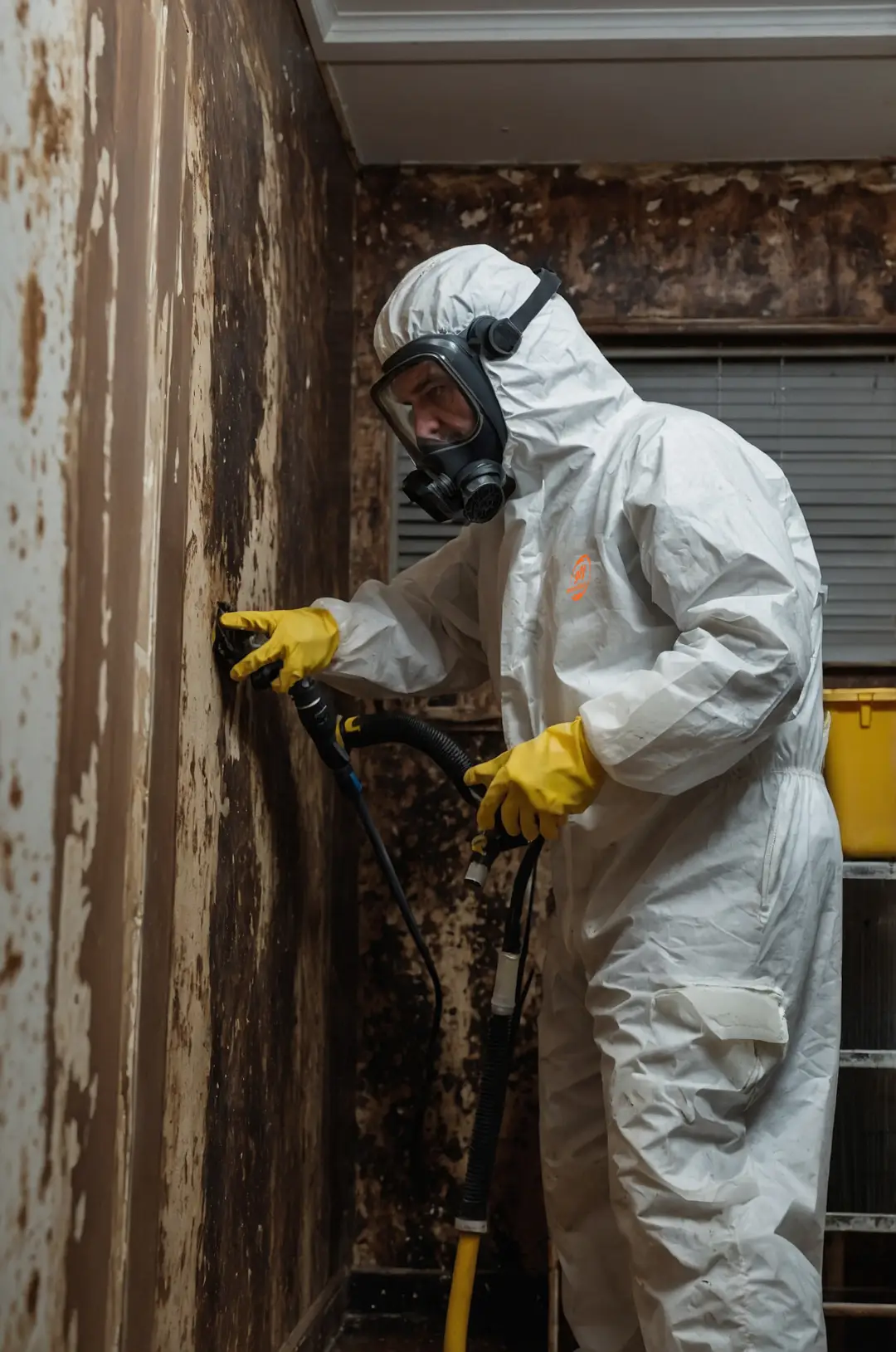
Mold Removal & Remediation in Kenosha, Racine, & Waukesha County
"Mold removal near me" searches spike every fall — and not by coincidence. The warm, wet summer months create ideal conditions in the basements and crawlspaces of Southeast Wisconsin's housing stock, and by September and October, homeowners are finding it — often first as a persistent musty odor before any visible growth appears. The region's older housing — much of it built before 1985 in communities like Racine's downtown neighborhoods, Caledonia's rural residential, and Brookfield's Waukesha County suburbs — carries decades of accumulated minor moisture infiltration behind original-era finishes. Under the right conditions, mold spores can begin colonizing within 48 hours of a moisture event, and prolonged exposure carries real health effects — allergy-like symptoms, sinus and respiratory irritation, and worse for anyone with asthma or a compromised immune system.
911 Restoration of Southeast Wisconsin performs mold remediation under IICRC S520 protocol — the industry standard that defines mold containment, HEPA filtration, source removal, and antimicrobial treatment. This is the standard insurance carriers and real estate transactions require. It is not surface treatment with store-bought chemistry. Owner Joe Minsky's crews bring IICRC certification to Waukesha County, Racine County, and Kenosha County, with 24/7 emergency response on every call.
Mold Inspection & Damage Assessment
Every job starts with a mold inspection — a visual and instrument-based assessment to find the moisture source and scope the problem, not lab sampling. We use a moisture meter to confirm elevated readings inside walls and subfloors, and an infrared camera to spot the temperature differentials where hidden water is feeding growth behind drywall, under flooring, or above ceilings. That mold damage assessment tells us exactly how far the colony has spread and what the remediation plan needs to cover before any work begins. (Formal air or surface testing is performed by an independent environmental lab; we coordinate that third-party testing but don't self-certify our own work.)
Our Restoration Services
Residential Mold Remediation — IICRC S520 Protocol
IICRC S520 mold remediation follows a defined sequence: complete a mold damage assessment and identify the moisture source; establish mold containment with physical barriers and negative air pressure; run air scrubbers and HEPA vacuums to capture airborne mold spores and restore indoor air quality; carry out porous materials removal of contaminated drywall, carpet, and insulation that can't be cleaned; apply antifungal treatment to the remaining structural elements; and coordinate independent post-remediation clearance testing through a third-party lab before the area is returned to use. This sequence applies whether the colony is 10 square feet or 100, and we document every step for insurance and real estate purposes.
Black Mold Removal in Southeast Wisconsin
Stachybotrys chartarum — commonly called black mold — requires the same IICRC S520 protocol as other species. What makes it significant is its association with chronic moisture and the health effects tied to prolonged exposure. Black mold develops where water intrusion has gone unaddressed for extended periods, often behind finished walls or in crawlspaces, and a heavy musty odor is frequently the first sign. Its presence is a reliable indicator of a structural moisture problem that needs to be corrected, not just remediated. We assess the moisture source as part of every mold remediation engagement.
Basement, Crawl Space & Attic Mold Remediation
Basements in Waukesha County's clay-soil communities — Brookfield, Muskego, New Berlin — and crawl space mold in rural Racine County properties near Caledonia are the most common conditions we see. High ambient humidity, limited air exchange, and original-era drainage create crawl space mold that persists year after year. Attic mold is the other frequent one: poor ventilation plus a roof leak grows mold across the sheathing, out of sight until a mold inspection finds it. Remediation without addressing the moisture source is temporary — so we identify and document the source (drainage failure, ventilation deficiency, foundation seepage) and recommend corrective action alongside the containment and cleanup.
Structural Restoration After Remediation
Removing the mold is only part of the job. Once the affected materials are out, structural restoration often includes drywall replacement where sheeting was cut away, and subfloor removal and rebuild where mold penetrated below the flooring. We also provide contents restoration — cleaning and restoring salvageable furniture, clothing, and documents affected by the mold — so belongings aren't simply thrown out with the drywall. Where mold has reached the ductwork, HVAC mold cleaning keeps the system from redistributing mold spores through the home every time it runs.
Commercial Mold Remediation in Southeast Wisconsin
Commercial mold in Southeast Wisconsin office buildings, Waukesha County medical facilities, Racine County manufacturing spaces, and Kenosha retail properties requires remediation that doesn't disrupt operations any more than necessary. Our commercial teams work with property managers on phased mold containment, flexible scheduling, and complete documentation for commercial insurance claims. IICRC S520 protocol applies at commercial scale — the standard doesn't change because the building is larger.
Post-Water-Damage Mold Prevention
Mold growth begins within 48 to 72 hours of a moisture event under the right conditions, so any water damage that isn't dried to IICRC protocol creates mold risk. Our water damage protocol includes antifungal treatment of affected structural materials as a preventive measure — not an add-on. A few practical mold prevention tips for Southeast Wisconsin homeowners: keep basement humidity under control with a dehumidifier, fix plumbing and roof leaks quickly, and don't ignore a musty odor even when nothing is visible. For properties with prior water events that weren't fully dried, a mold inspection before reconstruction is often necessary.
See What Southeast Wisconsin Locals Say About Our Mold Removal Services
"A mold inspector's report revealed my house had mold in the basement, kitchen and attic. To get rid of it required a large, complicated project that had many moving pieces. Connor coordinated well with the on-site contractor ensuring everyone could work at the same time. He handled surprises along the way in stride. With a job of this size, it was natural that judgement calls on his part would need to be made. His reasoning was consistently sound. It was made evident with each check in, that he puts a priority on learning what the property owner's wishes are and anticipates solutions. The mold inspector was brought back in at the end of the job to test if the work had been done properly. This gentleman said Connor and his crew set up containment the old school way — which he clarified as the 'right way' and most other remediators don't put in the effort to do so. He told me I was fortunate because he'd seen a lot of poor jobs throughout the years and he said I had found someone that cared to do the remediation correctly and effectively.
When that was completed I also had him do a post-remediation cleaning throughout the house. This required a lot of monotonous detailed work that was met with a great attitude — once again, with many successful judgment calls made. Throughout each step of the extended job, Connor gave good suggestions and often went out of his way to make sure I was satisfied with the results. In the final tally, Connor and Joe's 911 Restoration put me at ease during a difficult restoration, completed the job skillfully and charged a reasonable price. I recommend them." - Reid R
Where We Serve in Southeast Wisconsin
- Brookfield
- Caledonia
- Elm Grove
- Franklin
- Franksville
- Kenosha
- Muskego
- New Berlin
- Oak Creek
- Racine
- Sturtevant
- Union Grove
- Waterford
Why 911 Restoration of Southeast Wisconsin
- IICRC S520 Mold Remediation Specialist — the insurance and real estate standard, backed by full IICRC certification
- Full protocol: mold containment → HEPA vacuum & air scrubber filtration → porous materials removal → antifungal treatment → third-party clearance testing
- Independent post-remediation clearance testing coordinated and documented (performed by an accredited lab)
- Complete insurance documentation package on every job
- Real estate disclosure documentation available for home sellers
- Contents restoration and structural rebuild — drywall replacement and subfloor removal — under one contractor
- Commercial mold remediation at scale, with 24/7 emergency response
- Owner-operated by Joe Minsky — serving Southeast Wisconsin full-time
Frequently Asked Questions
What's the difference between mold removal and mold remediation?
Mold removal typically means physically taking mold-contaminated materials out. Mold remediation is the complete process: source identification, mold containment, HEPA vacuum and air scrubber filtration, porous materials removal, antifungal treatment of remaining surfaces, and coordinated third-party clearance testing. IICRC S520 defines remediation — it's what insurance carriers and real estate transactions require, and it's what we perform on every job.
Do you do the mold testing too?
We perform the mold inspection and mold damage assessment — the visual and instrument-based evaluation (moisture meter and infrared camera) that scopes the job — and the remediation itself. Formal air and surface testing, including post-remediation clearance testing, is handled by an independent environmental lab so the verification is impartial. We coordinate that testing and fold the lab's documentation into your file.
Is mold remediation covered by homeowners insurance in Wisconsin?
Mold coverage varies by policy. Mold from a covered water event — a pipe burst or appliance failure — is often at least partially covered; mold from long-term neglect or gradual infiltration typically has limited or no coverage. We document the origin of every mold condition and work directly with your adjuster regardless of coverage status.
How long does mold remediation take?
A typical residential job — one to three rooms with moderate contamination — takes 1–3 days for the remediation work. Independent clearance testing through the lab usually adds 2–4 days before reconstruction begins. Larger or more complex jobs take longer; we provide a timeline after the initial mold damage assessment.
What are the health effects of mold in the home?
Common health effects include nasal congestion, coughing, eye and skin irritation, and worsened asthma or allergy symptoms — more serious for infants, older adults, and anyone immunocompromised. Restoring indoor air quality through proper containment, HEPA filtration, and source removal is exactly why professional remediation matters.
Who's responsible for mold in a rental — landlord or tenant?
Wisconsin doesn't set a single mold statute, so landlord tenant mold responsibility generally comes down to the moisture source and the lease: tenants should report leaks and visible growth promptly, and landlords are generally expected to address the underlying moisture and remediate. We provide clear documentation either party can use, and the Wisconsin DHS publishes guidance on landlord tenant mold questions.
Can I stay in my home during mold remediation?
Often, yes for isolated areas. Mold containment barriers and negative air pressure prevent spore migration, so occupying other parts of the home is usually reasonable for a single room or crawl space. For whole-home remediation, temporary relocation is frequently advisable — especially for occupants with respiratory conditions.
How common is mold in Southeast Wisconsin basements?
More common than most homeowners realize. Clay-heavy Waukesha and Racine County soils create chronic basement moisture, Lake Michigan humidity affects Kenosha and Racine lakefront communities, and a housing stock heavy on pre-1985 construction means crawl space mold and attic mold conditions are widespread. Any home over 30 years old here with a finished basement or crawl space warrants periodic professional inspection.
Ready to Get Started?
We Answer 24/7/365. 45-Minute Response | IICRC-Certified | Full Insurance Support | Serving Waukesha County, Racine County & Kenosha County.