
Mold Remediation in Brookfield, WI | Expert Removal Services
Brookfield's Wet Basements Don't Just Cost You Money. They Cost You Air Quality.
Mold doesn't announce itself. It doesn't set off alarms or send water pouring across your floor. It grows silently — behind your finished basement drywall, under the carpet that got damp last spring and dried out on its own, inside the wall cavity where your sump pump discharge line condensates every summer. For Brookfield homeowners who deal with one of Wisconsin's most water-saturated spring seasons year after year, mold is not a hypothetical. It is a statistical likelihood.
The clay soils across Waukesha County that drive persistent basement moisture issues create ideal conditions for mold colonization in crawlspaces, rim joists, and below-grade framing. Homes in the Meadowbrook area, along Lilly Road, and throughout the established neighborhoods near Brookfield Road that experienced even minor basement flooding in recent years may already have active mold growth — whether visible or not. 911 Restoration of Southeast Wisconsin provides IICRC-certified mold inspection, containment, remediation, and post-treatment verification. We eliminate the problem at its source, not just at the surface.
Understanding Mold Risk in Brookfield, WI
Why Brookfield Homes Are Particularly Vulnerable
Brookfield's combination of heavy spring snowmelt, high groundwater pressure against aging foundation walls, and the region's naturally humid summers creates a recurring moisture cycle in below-grade spaces. Any basement that has experienced water intrusion — even an event that was dried with fans and a home dehumidifier — may have introduced enough residual moisture to support mold growth within wall cavities and under flooring.
Mold requires three things to thrive: moisture, an organic food source (drywall, wood, carpet), and temperatures above freezing. Every home in Brookfield provides at least two of those three elements by default. The moisture variable is what we control — or fail to control — during and after water events.
Health Consequences of Untreated Mold
The EPA and IICRC both classify mold remediation as a health-critical service for good reason. Sustained mold exposure is associated with respiratory symptoms, chronic sinus infections, aggravated asthma and allergy conditions, headaches, and fatigue. Children, elderly residents, and individuals with compromised immune systems face the greatest risk — and often the most serious symptoms appear before visible mold is ever identified.
Waiting to see mold before acting is waiting too long.
Our IICRC-Certified Mold Remediation Process
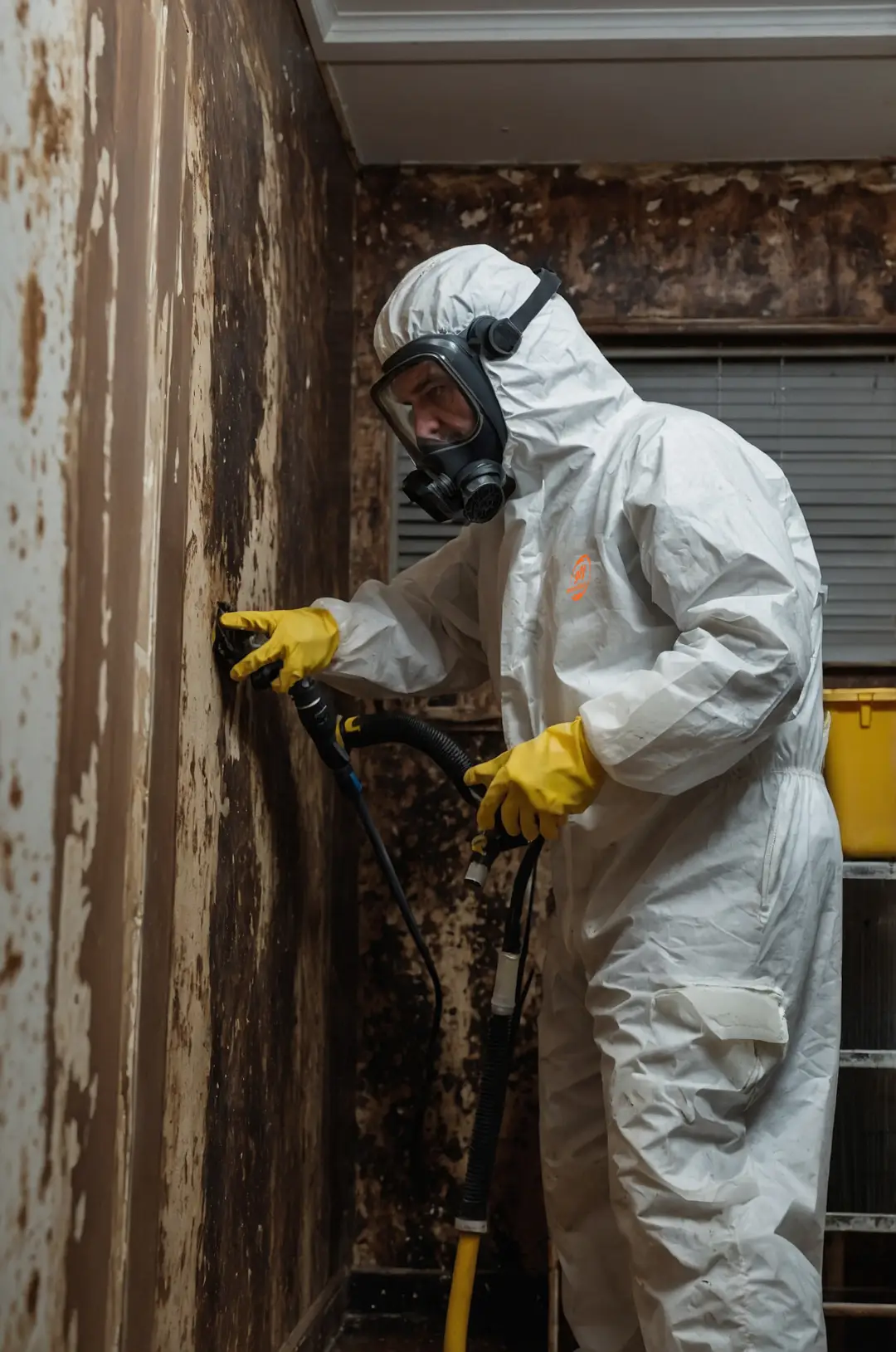
911 Restoration follows the IICRC S520 Standard for Professional Mold Remediation from initial assessment through final clearance. Every step is documented. Every claim is verifiable.
Step 1 — Mold Inspection & Moisture Assessment. Our certified technicians use thermal imaging, professional moisture meters, and air sampling to identify active mold colonies and map hidden moisture sources. We don't guess — we measure.
Step 2 — Containment & Negative Air Pressure. Before any physical remediation begins, we establish containment barriers and negative air pressure environments using HEPA-filtered negative air machines. This prevents mold spores from migrating to unaffected areas of your home during the removal process — a critical step that unlicensed operators routinely skip.
Step 3 — HEPA Removal of Affected Materials. Mold-colonized drywall, insulation, carpeting, and subfloor materials are removed using HEPA vacuum equipment and disposed of in sealed bags per Wisconsin environmental regulations. Salvageable structural materials are treated with EPA-registered antimicrobial agents.
Step 4 — HEPA Air Scrubbing. Commercial HEPA air scrubbers run continuously throughout and after remediation to capture airborne spore counts released during material removal. Air quality is treated as rigorously as surface conditions.
Step 5 — Source Control & Moisture Correction. Mold remediation without moisture source correction is a temporary fix. We identify and address the water intrusion pathway — whether that's a foundation crack, a failed vapor barrier, inadequate ventilation, or sump system deficiency — so that mold does not return.
Step 6 — Post-Remediation Verification. We conduct clearance testing after remediation is complete — air sampling and surface testing — to verify that mold levels have returned to normal background concentrations before reconstruction begins. You receive a written clearance report.
Step 7 — Full Reconstruction. We replace removed drywall, insulation, flooring, and trim. Your space is returned to its pre-mold condition with materials and workmanship that meet or exceed original construction standards.
Joe Minsky, Owner — 911 Restoration of Southeast Wisconsin
"Mold jobs are some of the most important work we do — and some of the most underestimated by homeowners. People see a small patch of discoloration behind a water heater or under a utility sink and assume it's a minor issue. I can't tell you how many times we've opened up a wall in a Brookfield home and found a colony that had been growing, untouched, for two or three years.
The families living in those homes weren't negligent. They just didn't know what was there. That's why I take mold remediation so seriously — because the consequences of getting it wrong are measured in health outcomes, not just property values. Every mold job my team handles in Brookfield follows IICRC S520 protocol to the letter. We test, we contain, we remove, we verify. And we don't leave until the air quality in your home is clean. That's the commitment — and it's not negotiable."
— Joe Minsky, Owner & IICRC-Certified Mold Remediation Specialist
Mold Remediation FAQ — Brookfield, WI
How do I know if I have mold in my Brookfield basement if I can't see anything?
Musty odors in below-grade spaces are the most common indicator of hidden mold, followed by unexplained respiratory symptoms that improve when occupants leave the home. Visual indicators include discoloration on drywall, bubbling paint, or efflorescence on concrete. The only definitive method is professional inspection with moisture mapping and, if indicated, air sampling.
Can I use bleach to treat mold in my Brookfield home?
Bleach is effective on non-porous surfaces like tile and glass, but it cannot penetrate porous materials like drywall, wood framing, or grout. It kills surface mold while leaving the root structure (hyphae) intact, which allows regrowth. It also contributes additional moisture to an already damp environment. Professional-grade antimicrobial treatments applied to prepared surfaces are significantly more effective and lasting.
Does homeowners insurance in Wisconsin cover mold remediation?
Coverage depends heavily on the cause of the moisture. If mold is a direct result of a covered water event (burst pipe, appliance malfunction), mold remediation is often covered under the same claim. Mold resulting from long-term seepage or neglected maintenance is typically excluded. We assist with claim documentation and adjuster communication to maximize your coverage outcome.
How long does mold remediation take for a typical Brookfield finished basement?
A single-room remediation in an unfinished basement typically takes 1–3 days. A finished basement with drywall removal, structural treatment, and post-remediation reconstruction generally runs 1–3 weeks depending on the extent of colonization. We provide a specific timeline following our initial assessment.
Your Brookfield Home's Air Quality Deserves a Professional Answer.
Mold doesn't resolve itself. Every day without professional remediation is a day it grows. 911 Restoration of Southeast Wisconsin is certified, equipped, and ready to protect your family's health.
Call us at (262) 294-6360 — We Answer 24/7/36545-Minute Response | IICRC S520 Certified | Post-Remediation Air TestingServing Brookfield, WI — Meadowbrook, Lilly Road, Brookfield Road, and All Surrounding Neighborhoods.