
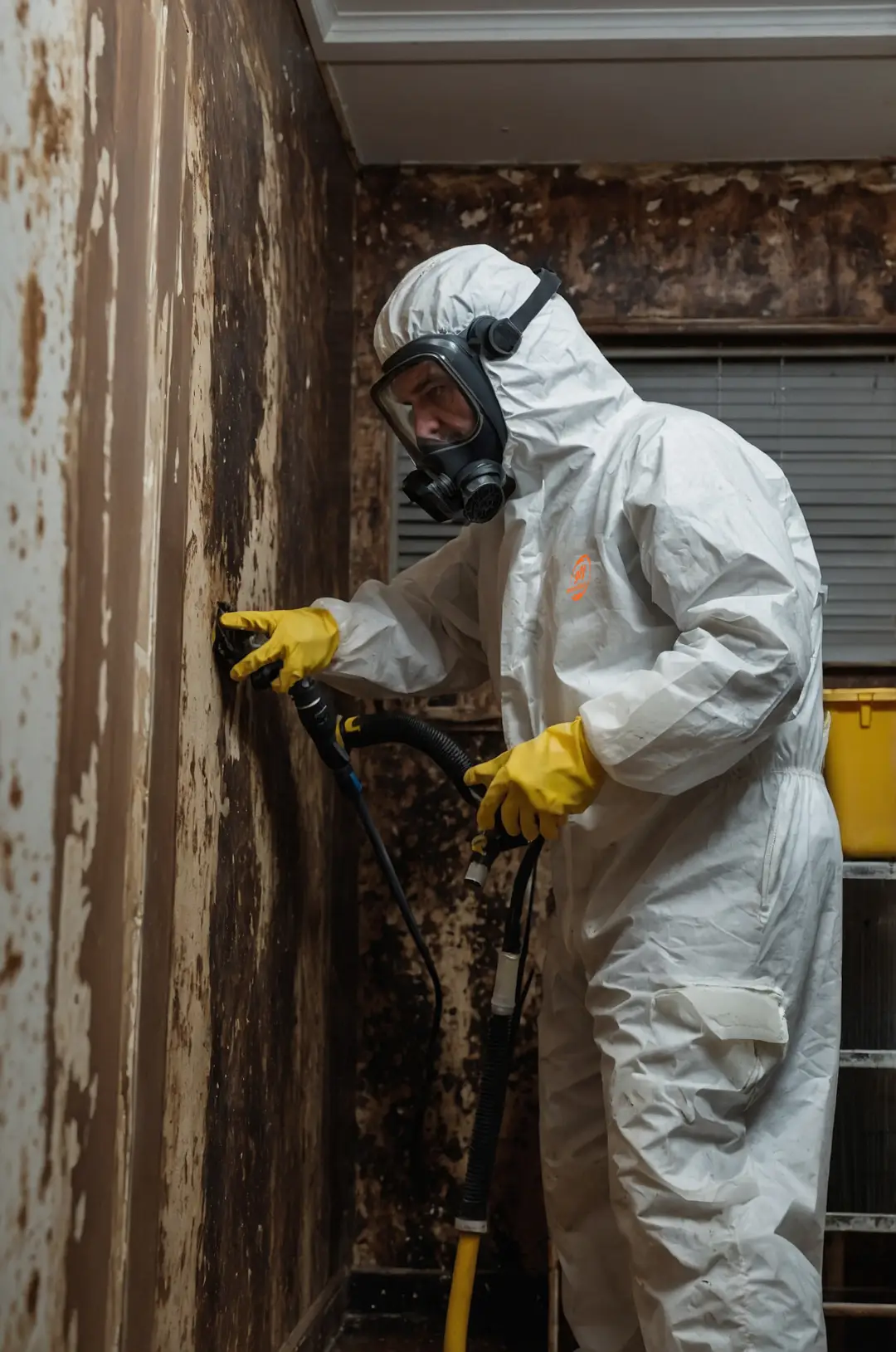
Professional Mold Removal in Oak Creek, WI
Trust Our Mold Remediation Specialists in Oak Creek for Your Project.
Mold doesn't announce itself with alarms or flooding. It grows in silence — behind drywall, beneath flooring, inside wall cavities — accumulating biological material for months or years before a musty odor, an unexplained health symptom, or a renovation discovery brings it to light. In Oak Creek, a rapidly growing Milwaukee County community anchored by Drexel Town Square, significant new commercial development, and a dramatic Lake Michigan bluff shoreline, the conditions that enable mold are woven into the environment itself.
At 911 Restoration of Southeast Wisconsin, we respond to mold as the health-critical issue it is. Not with surface treatment and reassurance, but with IICRC S520-certified inspection, containment, remediation, air quality testing, and written clearance documentation that proves — with data — that your home's air is clean. The Fresh Start we promise includes the air you breathe. That is not negotiable.
Why Oak Creek's Environment Produces Mold — Specific Conditions, Specific Risks
The Environmental Drivers
Oak Creek's mold risk profile is shaped by moisture intrusion in new construction where drainage and envelope details haven't fully settled, bluff-adjacent humidity from the Lake Michigan shoreline influence, and the hidden moisture problems that develop in rapidly constructed commercial properties. These conditions create biological growth in spaces that homeowners and property managers rarely inspect — attic assemblies, crawlspaces, rim joist areas, and behind the finished surfaces of renovated spaces. The mold that develops in these locations affects your indoor air quality through natural air movement throughout the structure, even when the growth is entirely invisible from the living spaces above.
The Drexel Town Square and the Drexel Town Square commercial area Moisture Profile
Properties near Drexel Town Square and throughout the Drexel Town Square commercial area operate in elevated moisture conditions that accelerate mold colonization in below-grade and poorly ventilated spaces. The moisture source may not be a single dramatic event — it may be the cumulative effect of seasonal humidity cycles, minor foundation seepage, or inadequate vapor management in crawlspaces and attic assemblies. For Oak Creek properties in these areas, proactive mold inspection is not a precautionary luxury. It is a practical maintenance necessity.
Hidden Mold Behind Renovated Surfaces
Many of Oak Creek's most significant mold discoveries occur during renovation — when a contractor pulls back tile, opens a wall, or removes original flooring and finds a colony that has been growing, untouched, for years. Custom bathroom surrounds installed over framing with residual moisture. Finished basement walls built against foundation surfaces with ongoing seasonal seepage. These scenarios produce mold that is invisible on inspection, invisible on sale, and potentially active for years before its presence becomes apparent.
Our IICRC S520-Certified Mold Remediation Process
Step 1 — Full-Structure Inspection: Attic, Crawlspace, and Concealed Assemblies. We inspect the spaces most commonly harboring mold in Oak Creek's building stock — attics, crawlspaces, rim joists, and below-grade assemblies — as standard components of every engagement. Thermal imaging, moisture meters, and air sampling provide objective data.
Step 2 — Air Quality Testing — Baseline and Post-Remediation. Air sampling before remediation establishes what is present and at what concentration. Post-remediation air testing verifies that mold levels have returned to normal background concentrations. You receive written results — not a verbal assurance.
Step 3 — Containment and Negative Air Pressure. Before any physical remediation begins, HEPA-filtered negative air pressure environments are established to prevent spore displacement into unaffected areas of your Oak Creek property.
Step 4 — HEPA Removal of Colonized Materials. Mold-colonized drywall, insulation, flooring, and organic structural materials are removed using HEPA vacuum equipment and disposed of per Wisconsin environmental regulations.
Step 5 — EPA-Registered Antimicrobial Treatment. All remaining structural surfaces receive EPA-registered antimicrobial solutions at verified concentrations and dwell times. Surface treatment alone without material removal is not IICRC-compliant remediation.
Step 6 — Moisture Source Correction — The Step That Makes Remediation Last. We identify and address the moisture pathway — foundation drainage, vapor barrier installation, ventilation correction, or sump system assessment — and coordinate with licensed trades as needed. Mold remediation without source correction is a temporary fix.
Step 7 — Post-Remediation Clearance Testing and Written Report. Written clearance documentation — air test results, surface test results, and remediation records — is provided for insurance, real estate, and personal records.
Step 8 — Full Reconstruction with Finish Matching. All removed materials are replaced, with finishes matched to existing property standards.
A Letter from the Owner — To Oak Creek Homeowners Dealing with Mold
"New construction mold is one of the most surprising findings for Oak Creek property owners. A building that looks perfect on the outside can have moisture issues built into its envelope during construction. I've seen this pattern throughout Oak Creek's development, and I know how to address it completely — not just treat the surface.
— Joe Minsky, Owner, 911 Restoration of Southeast Wisconsin
Mold Remediation FAQ — Oak Creek, WI
How do I know if I have mold in my Oak Creek home if I can't see anything?
A persistent musty odor — especially in below-grade or poorly ventilated spaces — is the most reliable indicator of hidden mold. Unexplained respiratory symptoms that improve when occupants leave the property are another. Professional inspection with thermal imaging and air sampling is the definitive diagnostic step.
Is mold in a Oak Creek property near Drexel Town Square more likely because of local environmental conditions?
Yes. Properties in the Drexel Town Square commercial area and near Drexel Town Square operate in moisture conditions — moisture intrusion in new construction where drainage and envelope details haven't fully settled — that elevate mold risk relative to less moisture-influenced locations. Annual inspection of crawlspaces, attic assemblies, and below-grade spaces is a reasonable precautionary measure for these properties.
Does Wisconsin homeowners insurance cover mold remediation?
Coverage depends on the cause. Mold resulting from a covered water event is often covered under the same claim. Mold from long-term moisture accumulation or neglect is typically excluded. We assist with documentation and adjuster coordination to maximize applicable coverage.
How long does mold remediation take for a typical Oak Creek property?
A single-room remediation in an unfinished space typically takes 1–3 days. A finished space with drywall removal and reconstruction runs 1–3 weeks. We provide a specific timeline following our initial inspection.
Oak Creek's Air Quality Deserves a Professional Answer.
Mold is not a cosmetic issue. It is a health event — and it doesn't resolve with the seasons. 911 Restoration of Southeast Wisconsin is certified, equipped, and ready.
Call (262) 294-6360 — We Answer 24/7/365 45-Minute Response | IICRC S520 Certified | Written Air Quality Clearance Reports Serving Oak Creek, WI — The Drexel Town Square Commercial Area, The Lake Michigan Bluff Corridor, and All Surrounding Areas