
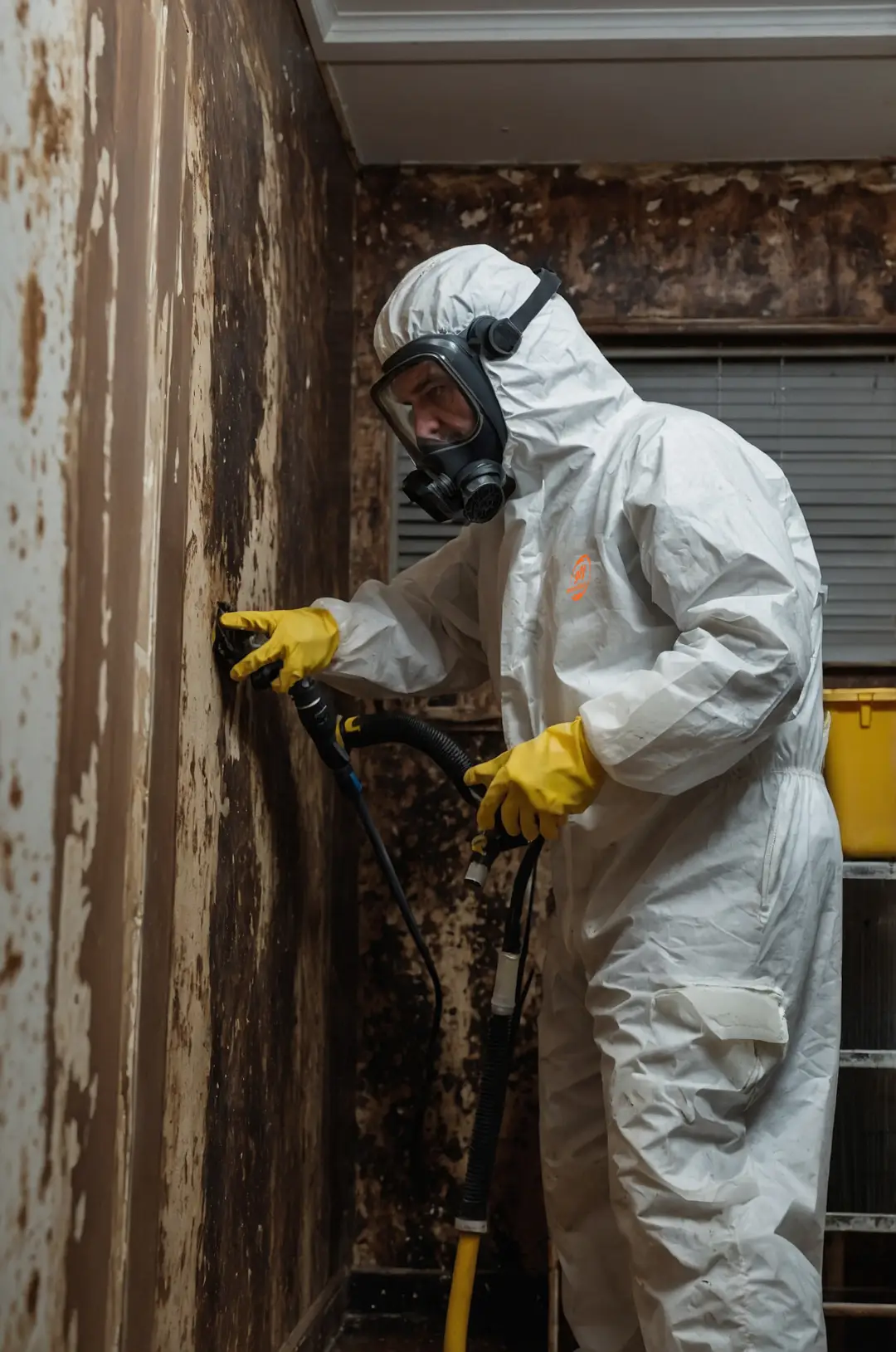
Expert Mold Removal in Franklin, WI: Breathe Easy Again
Franklin's Woods, River Corridors, and Ranch Attics Are Hiding a Mold Problem Most Homeowners Never See Coming.
Ask a Franklin homeowner about mold and they'll likely picture a flooded basement — visible, obvious, unmistakable. The reality is that the most consequential mold events in Franklin homes are the ones that develop in places no one routinely inspects: attic assemblies over decades-old ranch-style construction, wall cavities adjacent to the wooded Root River Parkway corridor, crawlspaces in established homes near Forest Park Middle School that have accumulated seasonal moisture year after year without intervention.
Franklin sits at a geographic and architectural intersection that creates mold risk from multiple directions simultaneously. The Root River Parkway brings humidity, canopy shade, and groundwater proximity. The city's substantial ranch-home stock presents attic ventilation challenges that were common to that era of construction and that many homes have never had corrected. The newer finished basements in Tuckaway Pines and the subdivisions near Franklin High School introduce below-grade living space risk every time a wet season taxes the sump system. 911 Restoration of Southeast Wisconsin is based here. We have inspected Franklin homes from their crawlspaces to their ridge vents. We know where the mold lives in this city — and we know how to eliminate it permanently.
Franklin's Mold Risk Drivers — Specific, Local, and Well-Documented
Attic Mold in Franklin's Ranch-Style Construction — The Most Overlooked Risk in the City
Franklin's residential core contains a significant inventory of ranch-style homes built from the 1950s through the 1980s. These homes were constructed under ventilation standards that were considered adequate at the time but are now understood to produce chronically under-ventilated attic assemblies. The combination of a low attic volume (common in ranch roof profiles), inadequate soffit-to-ridge air exchange, and kitchen and bathroom exhaust fans that were often vented into the attic rather than through the roof creates a moisture trap that accumulates biological material season after season.
Ranch homeowners in Franklin — particularly in the established neighborhoods around Forest Park Middle School and along the older streets west of the 76th Street corridor — frequently discover attic mold during roofing projects or energy audits. By the time it surfaces, the growth has often been active for multiple seasons. The remediation scope in these attics can be extensive, and it cannot be resolved without simultaneously correcting the ventilation deficiency that enabled colonization.
Root River Parkway Corridor — Elevated Ambient Moisture as a Baseline Condition
The wooded residential areas adjacent to the Root River Parkway experience consistently elevated ambient humidity driven by the river corridor's dense tree canopy, shade-limited sun exposure, and proximity to the water table influence zone of the Root River itself. Homes in the Whitnall View area and along the parkway-adjacent residential streets operate in a microclimate that is persistently more humid than Franklin's more open subdivisions — creating favorable mold conditions in basement rim joist areas, crawlspaces, and any below-grade framing that receives even minor periodic moisture.
In these homes, mold remediation without addressing the moisture control environment — vapor barriers, rim joist insulation, mechanical dehumidification in below-grade spaces — produces results that do not last through the next wet season.
Finished Basement Mold in Franklin's Newer Subdivisions
The finished basements that define the housing stock in Tuckaway Pines and the newer Franklin High School-area subdivisions represent significant homeowner investment — and significant mold risk after any water intrusion event. Finished basement mold in Franklin often traces to one of three sources: a sump failure event that was dried inadequately; minor but repeated foundation seepage that was never visible as standing water; or condensation in below-grade spaces during summer months when temperature differentials between the air-conditioned interior and the cool concrete walls create persistent moisture conditions on framing and drywall.
The tragedy of finished basement mold in these neighborhoods is that it typically develops behind walls that look perfectly fine — until the homeowner smells something, or a renovation project exposes the framing, or a home inspection surfaces findings that affect a sale.
Our IICRC S520-Certified Mold Remediation Process — Built for Franklin's Specific Conditions
Step 1 — Full-Structure Inspection Including Attic and Crawlspace — Standard, Not Optional. Every Franklin mold engagement starts in the attic and the crawlspace — the two spaces where mold most commonly establishes in this city's housing stock — before we assess the living spaces. We use thermal imaging, moisture meters, and air sampling to build a complete picture of the biological environment in your home.
Step 2 — Precise Scope Definition Before Any Work Begins. We define the remediation scope in writing — affected areas, materials to be removed, containment boundaries, and treatment methodology — before any physical work starts. Franklin homeowners deserve to understand what is being done and why, not discover it after the fact.
Step 3 — Attic-Specific Remediation Protocol. For the ranch attic scenario that is Franklin's most common mold finding, we remove colonized insulation, HEPA-vacuum all exposed roof sheathing and framing, treat with EPA-registered antimicrobial solutions at verified dwell times, and assess the ventilation configuration. We coordinate with roofing contractors for ventilation correction — often adding soffit baffles, ridge vent capacity, or correcting misrouted exhaust fans — before reconstruction begins. Mold remediation in a Franklin ranch attic without ventilation correction is not a complete job.
Step 4 — Containment and Negative Air Pressure — Preventing Spore Displacement. Before physical remediation begins in any finished space, we establish HEPA-filtered negative air pressure environments. This prevents the displacement of airborne mold spores into unaffected areas of your Franklin home during the removal process — a critical step that determines whether remediation actually solves the problem or simply relocates it.
Step 5 — Precise Material Removal in Finished Spaces. Colonized drywall, insulation, and flooring are removed methodically, with the goal of minimizing the removal footprint while achieving complete biological clearance. In Franklin's finished basements, this means careful section-by-section assessment to identify what is actually colonized versus what is merely adjacent.
Step 6 — Moisture Source Correction — Franklin-Specific Coordination. We identify the moisture pathway — whether that is a Root River Parkway-adjacent humidity condition, a sump system deficiency, or a crawlspace vapor barrier failure — and coordinate with the appropriate trades to address it before enclosed spaces are reconstructed.
Step 7 — Post-Remediation Clearance Testing — Written Results. Independent air and surface sampling confirms mold levels have returned to background concentrations. You receive a written clearance report with specific data. This report is relevant to Franklin homeowners for insurance documentation, real estate disclosure, and personal peace of mind.
Step 8 — Full Reconstruction Matched to Existing Finishes. We replace all removed materials — drywall, insulation, flooring, trim — and match existing finishes. Because we are based in Franklin and have rebuilt homes throughout the city, our finish-matching capability for Franklin's specific residential stock is particularly strong.
A Letter from the Franchise Owner — On Hidden Mold in Franklin Homes
"I've been in Franklin attics that told the whole story of a home's moisture history — every wet spring, every under-performing exhaust fan, every winter where ice accumulated at the eave line and melted slowly into the sheathing. Ranch attics in this city are where I've seen some of the most extensive mold growth of my career, and where I've also seen the most homeowner surprise. Because it's the attic. Nobody goes up there. Nobody sees it until something else brings them up there. Every mold job my team completes in Franklin gets a moisture source assessment, a corrective recommendation, and — when the homeowner wants it — a coordinated solution. We're based here. We're accountable here. The work we do in Franklin needs to last."
— Joe Minsky, Owner & IICRC-Certified Mold Remediation Specialist, 911 Restoration of Southeast Wisconsin — Franklin, WI
Mold Remediation FAQ — Franklin, WI
My Franklin ranch home has a musty smell in winter when the furnace runs. Is this attic mold?
A musty odor that intensifies when the HVAC system operates is a strong indicator of mold in a location that the air handling system is drawing from — including attic spaces with improperly terminated exhaust fans or HVAC components. This warrants professional inspection of the attic assembly, ductwork connections, and air handler environment. For Franklin ranch homes with older construction, this finding is more common than not.
Can mold from a sump failure in a finished Tuckaway Pines basement be resolved without full demo of the finished walls?
Sometimes, yes — depending on the duration of moisture exposure, the materials involved, and the moisture readings at time of inspection. We assess each situation individually. Where moisture readings in drywall and framing are below colonization thresholds and no visible or olfactory evidence of mold is present, targeted treatment and drying may be sufficient. We never recommend demolition that isn't warranted by data — and we document our findings so you can make an informed decision.
I'm selling my Franklin home and a buyer inspection flagged possible mold in the attic. What do we do?
We provide pre-sale mold inspection and remediation services on expedited timelines for Franklin real estate transactions. We assess immediately, remediate if indicated, and provide written clearance documentation suitable for real estate disclosure and closing files. Our familiarity with Franklin's residential construction makes our assessment timelines faster than those of inspectors less familiar with the city's specific housing stock.
Does homeowners insurance cover attic mold in a Franklin ranch home?
Attic mold resulting from long-term ventilation inadequacy is typically treated as a maintenance issue and excluded from standard Wisconsin homeowners policies. However, attic mold resulting from a sudden, accidental event — a failed roof vent, an active water intrusion — may be covered under the associated water damage claim. We assist with documentation to support coverage review in all cases.
Franklin's Mold Problem Is Hiding in Plain Sight — In Attics, Crawlspaces, and Behind Finished Walls.
Don't wait for the smell to tell you. 911 Restoration of Southeast Wisconsin is your hometown mold remediation team — based in Franklin, certified to the highest standard, and committed to getting it right the first time.
Call (262) 294-6360 — We Answer 24/7/365 Dispatched from Franklin | IICRC S520 Certified | Attic and Crawlspace Specialists Serving All of Franklin, WI — Whitnall View, Tuckaway Pines, Forest Park Area & Root River Parkway Corridor