
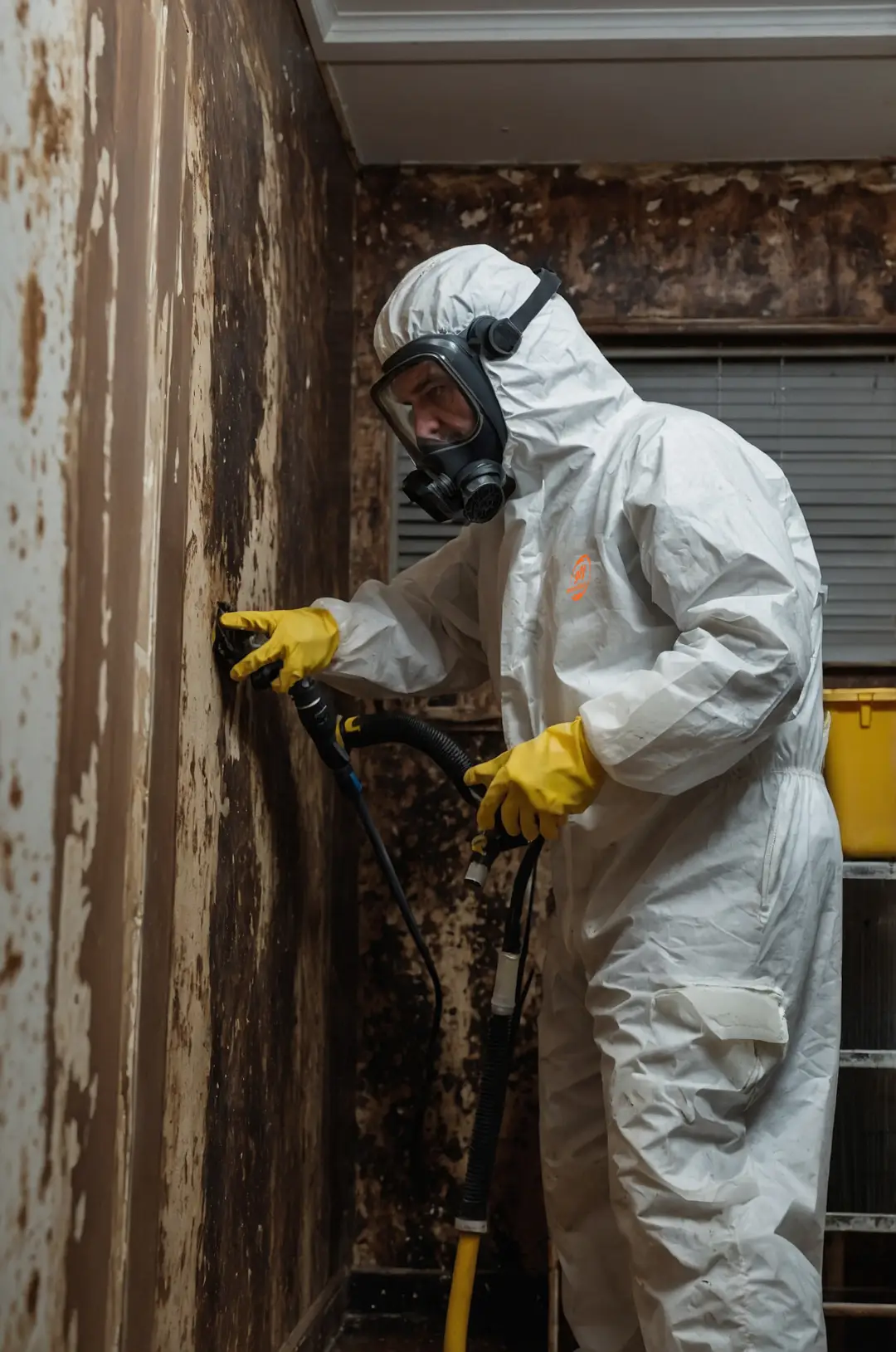
Mold Remediation in Caledonia, WI: Protecting Your Health & Property
Living Near the Lake and the River Has a Cost. For Caledonia Homes, It Often Shows Up in the Basement.
There is a particular quality to the air in eastern Caledonia on a warm summer morning — the kind of heavy, lake-influenced humidity that rolls in off Lake Michigan and settles into the Root River corridor like a blanket. It is part of what makes this community beautiful. It is also exactly the environmental condition under which Cladosporium, Penicillium, Aspergillus, and Stachybotrys — the mold species most commonly found in Racine County residential properties — thrive and colonize with remarkable speed.
Caledonia homeowners face a mold risk profile that is meaningfully shaped by geography. Persistent lakeside humidity, a high water table that keeps below-grade spaces perpetually close to saturation, and the recurring moisture events driven by Root River corridor flooding create conditions where mold is not an unlikely outcome — it is a predictable one, absent rigorous moisture management and prompt professional response. 911 Restoration of Southeast Wisconsin provides IICRC S520-certified mold inspection, containment, remediation, and post-treatment verification for homes across Caledonia — from the Linwood area and properties near 7 Mile Road to the bluff-adjacent communities near Cliffside Park.
Why Caledonia's Environment Accelerates Mold Growth
Lake Michigan Humidity as a Baseline Condition
Eastern Caledonia sits within the humidity influence zone of Lake Michigan. Relative humidity levels in Caledonia consistently run higher than inland Racine County communities during warmer months — and elevated ambient humidity means that below-grade spaces in Caledonia homes operate at a chronic disadvantage. Foundation walls that are merely damp rather than visibly wet can sustain mold growth on organic materials — wood framing, paper-faced drywall, carpet backing, upholstery — when ambient humidity provides enough supplemental moisture to cross the colonization threshold.
Root River Corridor and High Water Table Effects
Properties in the Root River corridor near 7 Mile Road and the Tabor and Linwood areas sit above groundwater tables that fluctuate significantly with seasonal precipitation and river levels. Even homes that have never experienced visible flooding may have experienced repeated, brief episodes of foundation seepage that were absorbed by insulation, rim joist framing, or below-grade wall materials — creating discrete mold colonization zones that grow invisibly over months and years before manifesting as odor, discoloration, or health symptoms.
Agricultural Runoff and Elevated Biological Load
Unlike urban stormwater, agricultural runoff in Caledonia's semi-rural areas carries elevated biological material — organic matter, microbial content, and moisture that has passed through soil rich in decomposing plant and animal material. When this water enters a basement or crawlspace, it doesn't behave like clean groundwater. It deposits biological substrate on structural surfaces that feeds mold colonization at an accelerated rate compared to clean water intrusion events.
The Crawlspace Problem in Older Caledonia Homes
Many of Caledonia's older residential properties — particularly farmhouses and mid-century homes in the Franksville border area and along the rural sections of Highway 31 — have unconditioned crawlspaces with inadequate vapor barriers or none at all. These spaces accumulate ground-sourced moisture year-round and are among the most common primary mold colonization sites in Racine County. Mold established in a crawlspace directly affects the air quality of the living space above through stack effect air movement.
Our IICRC S520-Certified Mold Remediation Process
Step 1 — Inspection, Air Sampling & Moisture Mapping. Our certified technicians use thermal imaging, calibrated moisture meters, and professional air sampling to identify active mold colonies and map moisture sources throughout the structure — including crawlspaces, rim joists, and attic assemblies. We distinguish between surface mold and systemic colonization before defining the remediation scope.
Step 2 — Containment and Negative Air Pressure Establishment. Before any physical remediation begins, we isolate the affected area using polyethylene barriers and establish negative air pressure using HEPA-filtered negative air machines. This is not optional — it prevents the displacement of mold spores into unaffected areas of your home during the removal process, which is the most common failure mode of unlicensed mold "remediation."
Step 3 — HEPA Removal of Colonized Materials. Mold-colonized drywall, insulation, carpet, and organic structural materials are removed using HEPA vacuum equipment and sealed for disposal per Wisconsin environmental regulations. Salvageable structural materials — concrete block, poured concrete, metal framing — are treated with EPA-registered antimicrobial solutions at verified dwell times.
Step 4 — Crawlspace and Below-Grade Treatment. For Caledonia properties with crawlspace mold — a common finding in rural and semi-rural construction — we remove contaminated insulation, treat all exposed framing, and install or restore vapor barrier systems to address the moisture source that enabled colonization in the first place.
Step 5 — HEPA Air Scrubbing Throughout and After Remediation. Commercial HEPA air scrubbers run continuously throughout the remediation process and for a defined period afterward to capture and reduce airborne spore counts to background levels before containment is removed.
Step 6 — Post-Remediation Clearance Testing. We conduct independent air sampling and surface testing after remediation is complete. You receive a written clearance report — with specific spore count data — before reconstruction begins. This documentation is suitable for insurance, real estate disclosure, and peace-of-mind purposes.
Step 7 — Source Correction and Full Reconstruction. Mold without moisture source correction returns. We identify and address the contributing moisture pathway — whether foundation crack repair, crawlspace vapor management, bathroom ventilation, or drainage regrading — and coordinate with licensed trades as needed. We then reconstruct all removed materials to pre-mold condition.
Franchise Owner Joe Minsky — To Caledonia Homeowners Dealing with Mold
"I'll tell you what I tell every Caledonia family that calls us about mold: you are not dealing with a cleanliness problem. You are dealing with a moisture management problem that has biological consequences. Living near the Root River and Lake Michigan in a home that has experienced any kind of water intrusion — even years ago — is a set of conditions that produces mold. It's not about neglect. It's about physics. The high-humidity crawlspaces near the river corridor. The rim joists in older farmhouses that have soaked up decades of ambient moisture. The finished basement walls that look fine on the outside and have a colony growing behind them that's been there since the last time the water table rose. I've seen it. I know what to look for. And I know how to fix it for good."
— Joe Minsky, Owner & IICRC-Certified Mold Remediation Specialist, 911 Restoration of Southeast Wisconsin
Mold Remediation FAQ — Caledonia, WI
My Caledonia home has a musty smell in the basement every spring. Is this normal given the proximity to the Root River?
A persistent musty odor is the most reliable indicator of active or recent mold growth. While elevated spring humidity is universal in Racine County, a musty smell that returns annually suggests a recurring moisture intrusion point — likely foundation seepage or a groundwater table interaction — that has established a recurring mold growth cycle. This warrants professional inspection, not simply increased dehumidification.
How do I know if my crawlspace has mold? I've never actually been in it.
Signs of crawlspace mold in an occupied home include musty odors that originate from floor level, cold or soft floor sections above the crawlspace, and occupants experiencing allergy-type symptoms that improve significantly when outside the home. Professional inspection with a thermal imaging camera and moisture meters is the definitive assessment — and for many Caledonia properties, it is a worthwhile precautionary step even without active symptoms.
Can mold established in a Caledonia basement affect my family's health even if we don't spend much time down there?
Yes. The stack effect — the natural upward movement of air through a structure driven by temperature differences — means that air from below-grade spaces moves continuously into living areas. Mold spores and mycotoxins entrained in that air movement affect indoor air quality throughout the home, not just in the basement or crawlspace where the colonization is occurring.
Does 911 Restoration provide mold inspection for real estate transactions in Caledonia?
Yes. We provide inspection and testing services for real estate buyers, sellers, and their agents — including written reports suitable for disclosure purposes. Given Caledonia's moisture-intensive environment, pre-purchase mold inspection is a prudent step for any property in the Root River corridor or in homes with crawlspace construction.
Your Caledonia Home's Air Quality Is Worth Protecting.
Mold in a Racine County home doesn't resolve with the seasons. It grows between them. 911 Restoration of Southeast Wisconsin is certified, equipped, and standing by to assess, remediate, and restore.
Call (262) 294-6360 — We Answer 24/7/365 45-Minute Response | IICRC S520 Certified | Written Clearance Reports Serving Caledonia, WI — Root River Corridor, Tabor, Linwood, 7 Mile Road & All Surrounding Areas.