
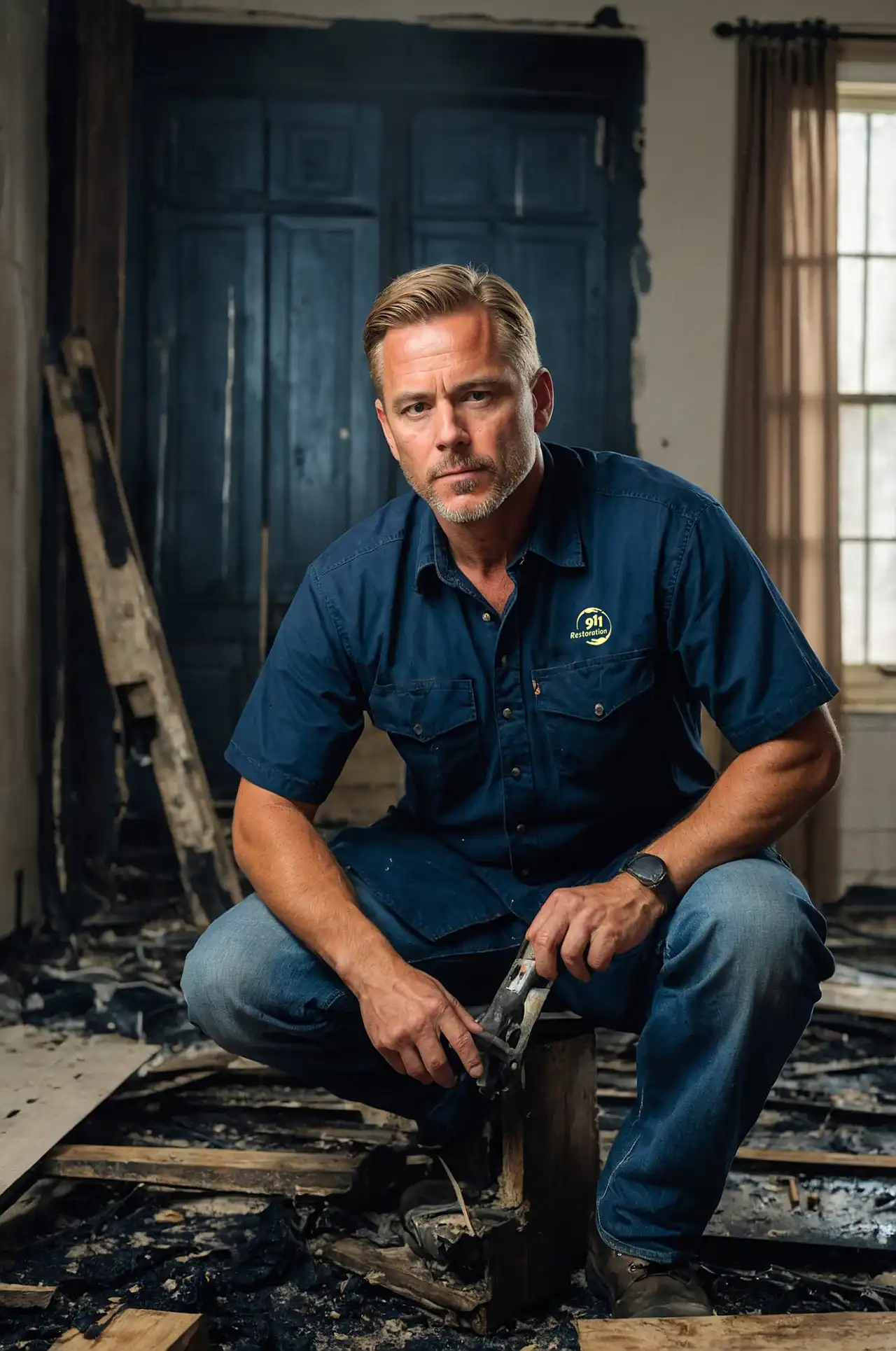
Fire & Smoke Damage Restoration in Kenosha, WI
The Fire Is Out. Now the Real Work Begins — & We're Already On the Way.
When the last fire truck leaves your Kenosha property, what remains is a structure that looks, smells, and feels nothing like the place you knew this morning. The visible char is only the beginning. Smoke has traveled through your HVAC system into rooms that never saw flame. Soot is actively corroding metal fixtures, discoloring surfaces, and etching glass. Suppression water is saturating framing and insulation, creating ideal conditions for mold before cleanup even begins.
The decisions made in the first 24 hours after a fire determine the ceiling on your recovery. 911 Restoration of Southeast Wisconsin responds to Kenosha fire calls within 45 minutes — not to make the situation feel better, but to begin the methodical, expert-driven process that leads to a genuine Fresh Start. One team. Emergency stabilization through full structural reconstruction. No handoffs. No gaps in accountability.
Fire and Smoke Dynamics in Kenosha's Building Stock
The Structures at Risk
Kenosha is a lakefront city with a rich industrial heritage and a historic residential fabric that spans more than a century of growth. The fire damage scenarios we respond to here involve historic residential properties on Kenosha's North Side — original framing, legacy wiring, and architectural details worth preserving — and large industrial facilities near the I-94 corridor with major business continuity stakes. Understanding how fire behaves in these specific structures — and what smoke migration patterns they create — is fundamental to developing a restoration scope that actually addresses the full damage footprint.
Smoke Travels Farther Than You Expect
Smoke does not stay in the room of origin. In Kenosha's residential and commercial structures, smoke travels through shared ductwork, open floor plans, stairwells, and wall cavities — depositing soot far from the visible burn zone. A kitchen fire can place measurable smoke contamination in second-floor bedrooms. A garage fire can affect a finished basement two floors below through shared mechanical pathways. Our assessment covers the entire structure, not just the visible damage.
The Soot Clock Is Running
Soot begins corroding metal surfaces, etching glass, and discoloring porous materials within hours of deposition. Every hour between fire suppression and professional remediation translates directly into expanded permanent damage. The properties near Harbor Park and in the historic North Side that call us fastest consistently see better material preservation outcomes — because we stop the corrosion clock as soon as we arrive.
Our Fire & Smoke Restoration Process — From Stabilization to Certificate of Occupancy
Step 1 — Emergency Stabilization (45 Minutes). Board-up, emergency tarping, site security, and utility coordination. We protect your structure from weather and unauthorized entry from the first night.
Step 2 — Structural Assessment — Every Assembly. Roof system, load-bearing walls, floor systems, attic, and all associated structures. Thermal imaging identifies heat damage in assemblies with no visible char. We scope before we demo.
Step 3 — Surface-Specific Soot and Smoke Remediation. Dry sponge, chemical sponge, wet wash, and HEPA vacuum — the correct technique for each surface type. Plaster, hardwood, stone, metal, drywall, and cabinetry each require a different approach. Our technicians are trained in all of them.
Step 4 — HVAC System Decontamination. Complete duct cleaning, air handler treatment, and filter replacement before the system is cleared for operation. A structurally restored Kenosha home that still has smoke-contaminated ductwork will smell like fire every time the furnace runs.
Step 5 — Molecular Odor Elimination. Thermal fogging and hydroxyl generation address smoke odor compounds at the molecular level — in framing, insulation, and soft goods that surface cleaning cannot reach. Odor clearance is verified, not assumed.
Step 6 — Contents Inventory, Pack-Out, and Specialist Cleaning. All salvageable personal property is inventoried, packed, and transported for professional cleaning and climate-controlled storage during reconstruction.
Step 7 — Full In-House Reconstruction. We rebuild — framing, roofing, insulation, drywall, flooring, cabinetry, trim, and paint — with finish matching and Racine County permit management. One team, from the first board-up to the final walkthrough.
From the Owner — To Kenosha Families After a Fire
"Kenosha's historic North Side homes are irreplaceable. The craftsmanship, the architectural character, the history embedded in those structures demands restoration that honors what was there. When fire damages one of these properties, I respond with that specific commitment — and for Kenosha's industrial properties, with the large-loss capability those structures require."
— Joe Minsky, Owner, 911 Restoration of Southeast Wisconsin
Fire & Smoke Damage FAQ — Kenosha, WI
How soon can reconstruction begin on my Kenosha property after a fire?
Reconstruction begins after structural assessment is complete, smoke and soot remediation is finished, and the structure has reached IICRC dryness standards. For most contained Kenosha fire events, reconstruction begins within 7–14 days of fire suppression.
Can smoke odor be fully eliminated from a Kenosha home, or does it linger permanently?
With proper molecular-level treatment — thermal fogging, hydroxyl generation, and HVAC system decontamination — smoke odor can be fully eliminated. The key is addressing odor compounds embedded in structural materials, not just surface residues. Odor that returns after apparent treatment indicates incomplete remediation of structural saturation.
Does my Wisconsin homeowners insurance cover full fire damage reconstruction?
Fire is among the most consistently covered perils in standard Wisconsin homeowners policies. Coverage typically includes demolition, full reconstruction to pre-loss condition, contents losses, and additional living expenses during displacement. We assist with documentation and adjuster coordination throughout.
Can you match original finishes in a Kenosha property during reconstruction?
Yes. Matching existing flooring species, stain colors, trim profiles, cabinetry styles, and paint finishes is standard in our Kenosha reconstruction work. We source through specialty suppliers when original materials require it.
Kenosha's Homes and Businesses Can Be Rebuilt. Let's Begin.
Call (262) 294-6360— We Answer 24/7/365 45-Minute Response | Full In-House Reconstruction | IICRC S700 Certified Serving Kenosha, WI — The Historic North Side, The I-94 Industrial Corridor, and All Surrounding Areas