
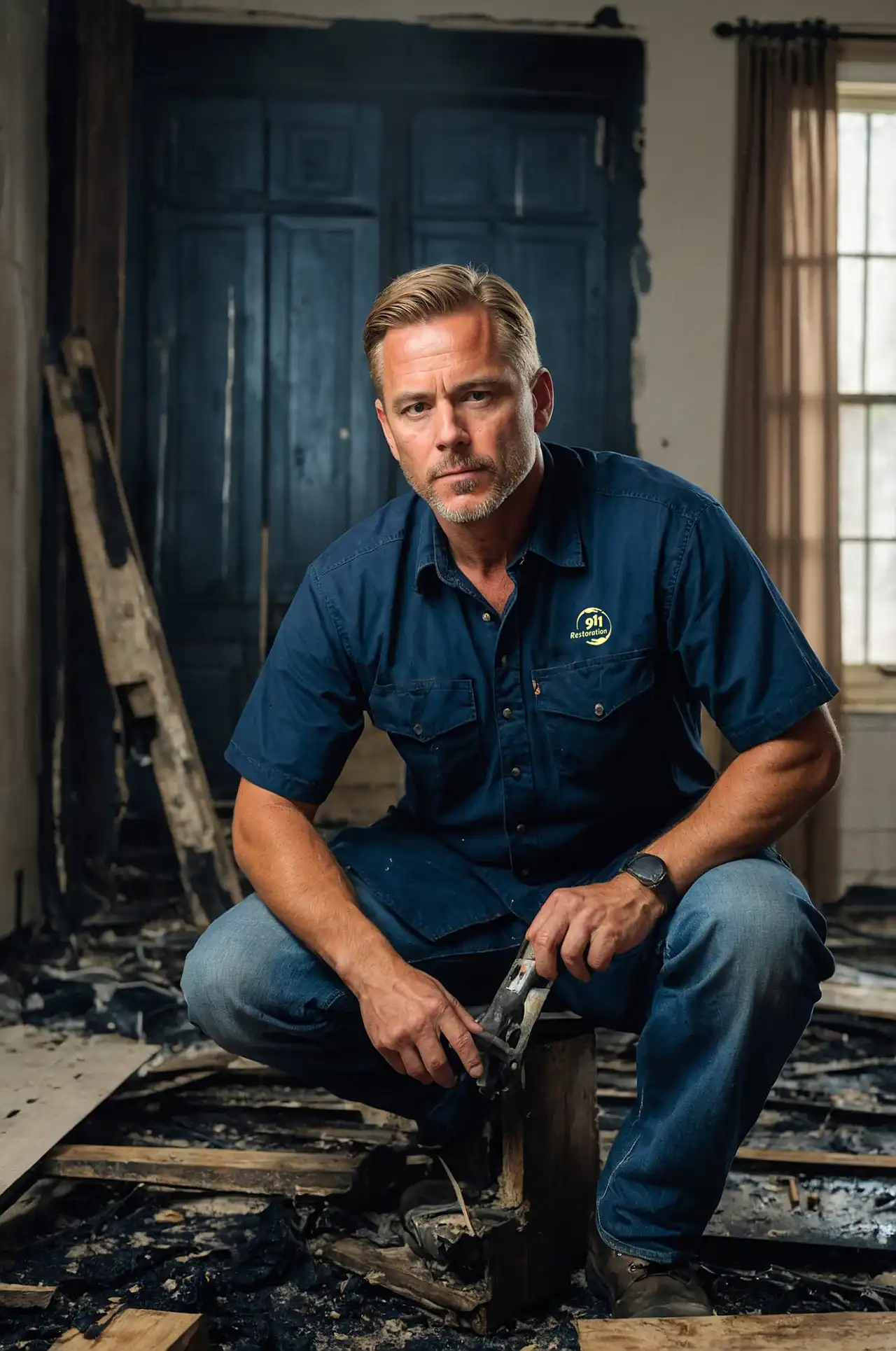
Fire & Smoke Damage Restoration in Elm Grove, WI
Smoke Doesn't Respect Fine Furnishings. A Skilled Restoration Team Does.
In a Village where custom drapery panels are selected by designers, where upholstered furniture represents investment measured in the thousands per piece, and where original architectural millwork defines the character of homes that have been lovingly maintained for decades — fire and smoke damage is not simply a structural problem. It is a threat to the accumulated character of a property, rendered in soot deposited on plaster cornices, smoke absorbed into silk cushions, and acrid odor compounds locked into the fibers of hand-knotted rugs.
911 Restoration of Southeast Wisconsin approaches fire and smoke damage restoration in Elm Grove with the same discipline and material consciousness that the Village's properties demand. We respond within 45 minutes with emergency stabilization capability and follow with IICRC-certified smoke remediation that addresses every surface, system, and material in the affected environment — structural and decorative alike. We do not apply generic cleaning protocols to exceptional homes. We assess what is in the space, understand what each material requires, and deliver restoration work that returns your home to its full integrity.
Understanding Fire and Smoke Damage in Elm Grove's High-Value Homes
Smoke Migration Through Premium Interior Assemblies
Modern Elm Grove homes — whether newly constructed along Juneau Boulevard or extensively renovated in the Indian Hills neighborhood — feature complex interior assemblies that create unexpected smoke migration pathways. Whole-home audio and low-voltage cabling runs, custom built-in shelving with recessed lighting, coffered and tray ceiling assemblies, and open-plan floor arrangements allow smoke to travel through concealed pathways and deposit soot in spaces far removed from the fire's origin. A kitchen fire can deposit odor compounds in master bedroom closets two floors above. A basement utility event can introduce smoke into a first-floor media room through shared ductwork before the fire is suppressed. Thorough smoke damage assessment in an Elm Grove home requires understanding the building's specific mechanical and architectural layout — not a room-by-room visual inspection alone.
The Soot Problem on Premium Surfaces
Soot is a mildly acidic compound that begins etching and discoloring surfaces within hours of deposition. On natural stone countertops, soot can cause permanent staining if not properly addressed with the correct chemistry. On painted plaster surfaces — common in Elm Grove's older and custom-constructed homes — improper cleaning can lift paint or leave smearing that requires full refinishing. On polished metal hardware and light fixtures, soot corrosion begins quickly and can cause permanent surface degradation. Our remediation technicians are trained in surface-specific soot cleaning protocols, using the correct cleaning methodology for each material type rather than a single universal approach.
High-End Contents and the Case for Professional Pack-Out
Elm Grove homes in Juneau Woods and Indian Hills frequently contain furnishings, art, and personal property whose value warrants contents specialist handling rather than standard pack-out. Upholstered furniture, area rugs, window treatments, original artwork, and custom furniture pieces require cleaning and storage conditions appropriate to their material composition. Our team inventories, documents, and packs all salvageable contents, and coordinates with specialty textile and art restoration cleaners when items warrant that level of expertise.
HVAC System Contamination
Smoke that enters an HVAC system during a fire event deposits odor compounds in ductwork, air handler components, and filter housings that can recirculate throughout the home every time the system operates — months after the fire. Complete fire restoration in an Elm Grove home requires comprehensive HVAC duct cleaning and system inspection as a non-negotiable component, not an optional line item.
Our Fire & Smoke Damage Restoration Process — White-Glove Standard
Step 1 — Emergency Stabilization and Property Protection (45 Minutes). We arrive with boarding materials, emergency tarps, and documentation equipment. We secure the structure, protect undamaged areas of the property from weather intrusion and additional soot migration, and begin the documentation that your insurance carrier requires from the first hours.
Step 2 — Comprehensive Smoke and Soot Mapping. Room-by-room assessment using visual inspection, thermal imaging, and air quality sampling identifies the full extent of smoke penetration — including concealed cavities, HVAC system components, and secondary areas affected by migration. We document every finding photographically before any cleaning begins.
Step 3 — Surface-Specific Soot Remediation. Using dry sponging, chemical sponge cleaning, wet washing, and ultrasonic cleaning as appropriate to each surface type, we remove soot deposits from structural surfaces, architectural details, cabinetry, light fixtures, and decorative elements. The technique applied to a plaster cornice is different from the technique applied to a granite countertop — and our technicians know the difference.
Step 4 — HVAC System Cleaning and Odor Treatment. Ductwork, registers, air handler components, and filtration systems are cleaned to remove smoke residue and deodorized before the system is cleared for operation. This step is completed before any other odor treatment, because a contaminated HVAC system will undermine all surface deodorization work.
Step 5 — Deep Odor Elimination — Molecular-Level Treatment. Thermal fogging, hydroxyl generation, and targeted ozone treatment (in unoccupied areas) work at the molecular level to eliminate odor compounds that have penetrated porous materials — wood framing, insulation, soft goods — beyond the reach of surface cleaning. We do not consider the job complete until ambient air quality has returned to pre-event standards.
Step 6 — Contents Professional Cleaning and Climate-Controlled Storage. All inventoried contents are transported to our facility for specialist cleaning — including coordination with textile cleaners for upholstered furniture, drapery, and area rugs, and with art restoration specialists for affected original works. Items are stored in climate-controlled conditions during reconstruction and returned upon completion.
Step 7 — Premium Reconstruction with Finish Fidelity. We reconstruct affected areas with materials and craftsmanship that match the existing property standard — matching millwork profiles, plaster finishes, paint sheens, hardwood species and stain tones, and cabinetry styles. Elm Grove homes are not finished to a generic standard, and our restoration work is not either.
A Note from the Franchise Owner — To Elm Grove Families After a Fire
"Fire damage in an Elm Grove home carries a dimension that I want to acknowledge directly: these properties hold tremendous personal and financial significance. The architectural details, the custom finishes, the furnishings selected over years — they are the expression of a life built here, in this Village, in this home. When smoke and soot touch those things, it isn't just property damage. It's something more personal.
My team has worked in high-value properties throughout Waukesha County for more than a decade, and the Village of Elm Grove represents the standard of care I hold my team to most precisely. We treat every surface in an Elm Grove home — whether it's a plaster ceiling detail in a home near Village Park or custom walnut built-ins in a Juneau Woods renovation — as something worth preserving, cleaning properly, and restoring faithfully. That attention to detail is not an option on our Elm Grove jobs. It is the baseline."
— Joe Minsky, Owner & IICRC-Certified Restoration Specialist, 911 Restoration of Southeast Wisconsin
Fire & Smoke Damage FAQ — Elm Grove, WI
Can smoke odor be permanently eliminated from high-end upholstered furniture in an Elm Grove home?
In most cases, yes — with the appropriate cleaning methodology. Upholstered furniture requires treatment that addresses odor compounds absorbed into fabric and fill material, not just surface deposits. We coordinate with specialist textile cleaners for high-value pieces and use hydroxyl treatment for soft goods that cannot leave the property. Pieces that have sustained direct thermal damage or structural compromise to their frame are assessed separately for repair versus replacement.
My Elm Grove home has original plaster walls and ceilings throughout. Does smoke remediation require replastering?
Not necessarily. Soot on plaster can often be cleaned with the correct dry and wet chemical sponge methodology without replastering if the cleaning is performed promptly and correctly. However, improperly applied cleaning chemistry, excessive moisture, or physical abrasion can damage plaster surfaces that would otherwise be preservable. Our technicians are specifically trained in plaster-appropriate cleaning techniques.
How do you handle smoke damage in an Elm Grove home's wine storage or climate-controlled spaces?
Climate-controlled spaces require careful smoke remediation that preserves the integrity of the humidity and temperature control system. We sequence remediation to avoid introducing conditions that would affect wine inventory or stored valuables, and we coordinate with your climate control system technician for post-remediation system assessment before restoring full operation.
Is a full kitchen rebuild necessary after a kitchen fire, or can original cabinetry be restored?
This depends on direct thermal exposure, soot penetration, and structural integrity of the cabinetry. Custom cabinetry that has not experienced direct flame exposure and has been promptly soot-cleaned may be preservable. Cabinetry with structural compromise, deep odor penetration into the substrate, or irreparable finish damage warrants replacement. We provide a specific, item-by-item assessment with photographic documentation for insurance purposes.
Elm Grove's Finest Homes Deserve Restoration That Honors Them.
Fire and smoke damage calls for precise, experienced hands — and a team that understands the standard of the property they're working in. That's the 911 Restoration commitment to the Village of Elm Grove.
Call (262) 294-6360 — We Answer 24/7/365 45-Minute Response | Premium Contents Handling | IICRC S700 Certified Serving Elm Grove, WI — Indian Hills, Juneau Woods, Village Park & Juneau Boulevard Corridor.