
Water Damage Restoration in Elm Grove, WI | 24/7 Professional Response
When Water Reaches a Basement in Indian Hills or Juneau Woods, Every Minute Counts
Elm Grove is not a community where water damage is a minor inconvenience to be dried out with box fans. The Village's homes represent decades of investment — custom millwork, designer-selected hardwood floors, finished basement living spaces with dedicated home theaters, wine cellars, fitness rooms, and guest suites appointed to a standard that rivals many primary living floors. When water reaches those spaces, the question is not just how quickly it can be extracted. The question is how skillfully it can be managed so that materials worth preserving are actually preserved — and the homeowner's investment is protected from avoidable loss.
911 Restoration of Southeast Wisconsin provides water damage restoration in Elm Grove with a level of care, precision, and property consciousness that matches the character of the Village. We respond in 45 minutes. We deploy IICRC-certified technicians trained in the specific requirements of high-value interior environments. And we treat every decision — from the extraction equipment we position on your hardwood floor to the drying temperature we set against your custom cabinetry — as a decision with real consequences for a property you have worked hard to maintain.
Elm Grove's Water Damage Risk Profile: Specific, Seasonal, and High-Stakes
Underwood Creek Overflow and Corridor Flooding
Underwood Creek runs through and along the edges of Elm Grove, and its behavior during significant rainfall events directly affects the water table and drainage performance of creek-adjacent properties throughout the Village. During intense spring storms or extended wet periods, creek levels rise and the surrounding groundwater table can elevate rapidly — pushing moisture against foundation walls, through window well seals, and up through floor drains in below-grade living spaces. Properties in the Indian Hills neighborhood and along the western sections of the Village near the creek corridor are particularly susceptible to this seasonal pressure dynamic.
Heavy Tree Canopy — Elm Grove's Beautiful Liability
Elm Grove's extraordinary mature tree canopy is one of the Village's most treasured characteristics. It is also one of the most consistent contributors to water damage in Village homes. Dense canopy coverage over rooflines means that gutters fill with leaf, twig, and seed debris at an accelerating rate during fall, and that roof surfaces dry slowly after precipitation — creating persistent moisture conditions along fascia, soffit, and roof valley assemblies. Overflowing gutters direct water against foundation walls rather than away from them. Slow-drying roof valleys develop ice dam conditions in winter, allowing meltwater to travel beneath roofing into attic and wall assemblies. In Elm Grove, gutter management is not optional maintenance — it is a direct line item in water damage prevention.
High-Value Finished Basement Flooding
Elm Grove's residential market has seen extensive renovation investment in below-grade living spaces. A finished basement in Indian Hills or Juneau Woods may include radiant-heated tile, engineered hardwood or luxury vinyl plank throughout, custom built-in cabinetry, media room components, and bathroom fixtures selected to match the quality of above-grade spaces. When water reaches these areas — whether through foundation seepage, window well failure, or an overhead plumbing event — the financial exposure is significant. The appropriate response requires equipment and technique that preserves materials where possible and documents losses completely where replacement is required.
Our Water Damage Restoration Process — Calibrated for Elm Grove Properties
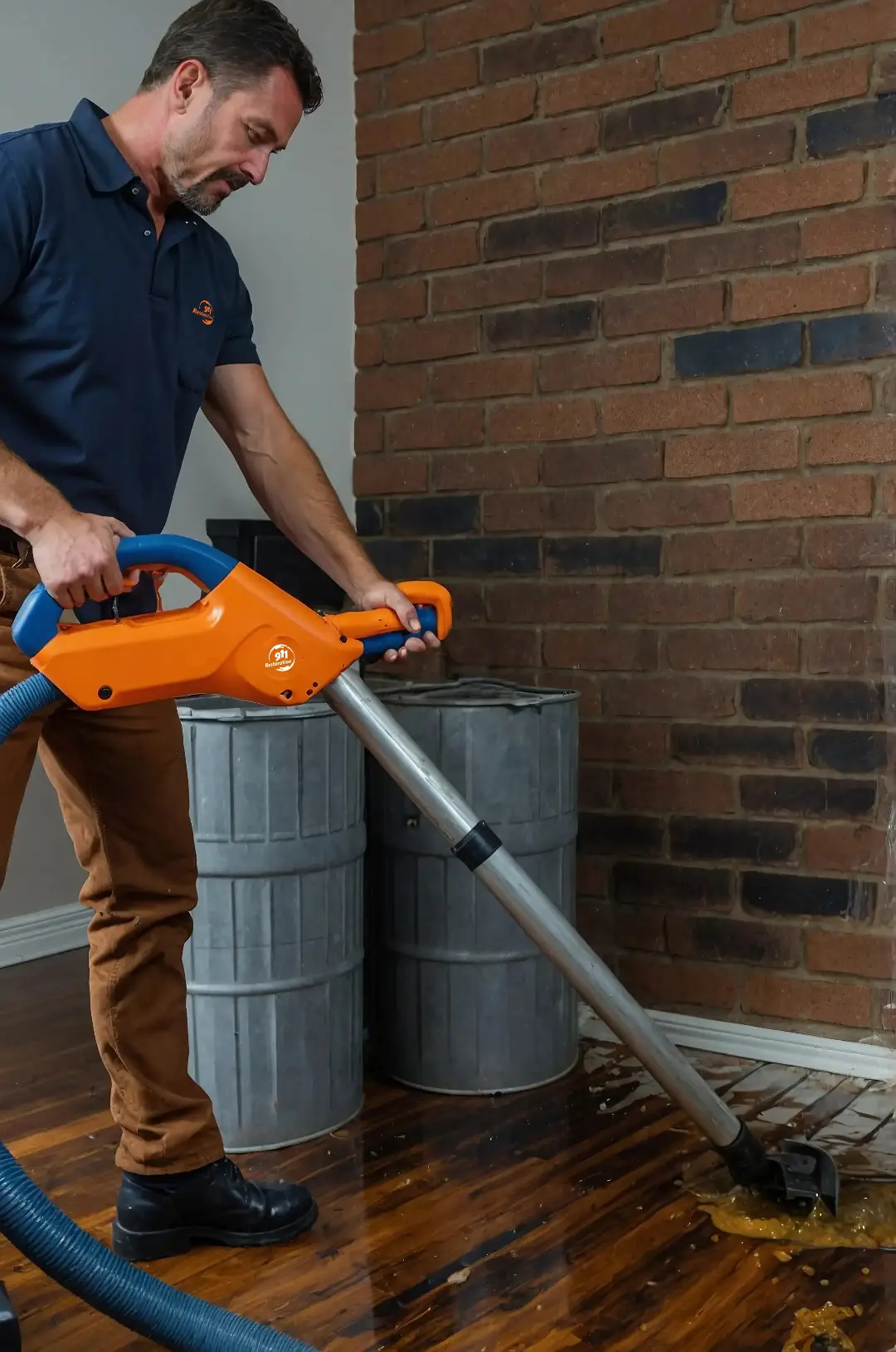
Step 1 — 45-Minute Response with Property-Appropriate Equipment. We arrive with commercial extraction equipment and immediately assess the material inventory in affected spaces. Hardwood floor extraction technique differs from carpet extraction. Custom cabinetry requires a different drying approach than standard construction drywall. Our assessment begins with the materials at risk, not just the volume of water present.
Step 2 — Precision Moisture Mapping. Thermal imaging cameras and calibrated moisture meters trace water migration behind finished wall assemblies, under flooring, inside built-in cabinetry, and through ceiling systems. In a high-end Elm Grove finished basement, visible water is rarely the full story. We map the complete moisture footprint before determining scope.
Step 3 — Material-Specific Extraction and Drying Strategy. Engineered hardwood, luxury vinyl plank, natural stone tile, and custom wood millwork each respond differently to moisture and to drying conditions. We set drying parameters — air mover placement, dehumidifier configuration, temperature targets — based on the specific materials in the affected space, not a generic residential drying template. Drying is monitored with daily moisture readings and adjusted based on data.
Step 4 — Hardwood Floor Assessment and Cupping Management. Solid and engineered hardwood floors that experience water intrusion often develop cupping — the raised-edge, dished-center deformation caused by differential moisture absorption. Managed drying under controlled conditions can reduce or eliminate cupping in engineered hardwood; solid hardwood results vary by species, installation method, and moisture exposure duration. We assess every hardwood floor individually and document findings for insurance purposes, giving you accurate information rather than optimistic generalities.
Step 5 — Mold Prevention Protocol. In an enclosed, finished basement with luxury materials, the conditions for mold colonization are favorable once moisture is introduced. We apply EPA-registered antimicrobial treatments to all affected surfaces as a standard step — not an upsell — to prevent secondary biological damage that would expand the restoration scope and complicate insurance claims.
Step 6 — Contents Protection and Inventory. Furniture, rugs, artwork, electronics, and personal property in affected areas are assessed for salvageability, inventoried, and either protected in place, relocated within the home, or transported to our climate-controlled facility. High-value items are handled with the care they warrant.
Step 7 — Full Reconstruction with Finish Matching. We restore all affected materials to pre-damage condition — including matching existing flooring species, stain colors, cabinetry profiles, and paint finishes. Elm Grove homeowners should not have to accept a "close enough" rebuild. We hold ourselves to the standard of the home we are working in.
Note from the Franchise Owner — To Elm Grove Homeowners
"Elm Grove is a Village that takes pride in its homes, and I believe it deserves a restoration partner that takes the same pride in its work. Over more than ten years serving Waukesha County, I've worked in properties throughout the Village — the large colonials on quiet streets in Indian Hills, the carefully maintained mid-century homes near Village Park, the extensively renovated homes in Juneau Woods where a finished lower level represents as much investment as the rest of the house combined.
What I've learned about working in Elm Grove is that the standard is high — and that's exactly as it should be. When water reaches a space that has been appointed with that level of care, the response has to match. My team understands that. We treat your property with the same deliberate attention to materials, finishes, and long-term outcomes that you invested in building it. The 45-minute response time is the urgency. The attention to your hardwood floors, your cabinetry, your custom tile — that's the craft. Both matter. Both are what we deliver."
— Joe Minsky, Owner & IICRC-Certified Restoration Specialist, 911 Restoration of Southeast Wisconsin
Water Damage FAQ — Elm Grove, WI
Can engineered hardwood floors in my Elm Grove basement be saved after water exposure, or do they need to be replaced?
Engineered hardwood has a higher moisture tolerance than solid hardwood, and with prompt professional extraction and controlled drying, many engineered hardwood floors can be preserved — particularly if water exposure duration was short. We assess each floor individually using moisture readings and visual inspection, provide a clear recommendation based on data rather than convenience, and document everything for your insurance claim. Solid hardwood outcomes depend significantly on species, installation method, and exposure time.
How does Underwood Creek's seasonal behavior affect water damage risk for homes in the Indian Hills and western Village areas?
When Underwood Creek rises during significant rainfall events, the water table in surrounding areas elevates with it — sometimes significantly. This groundwater pressure increase can push moisture through foundation walls and window wells even in homes that sit well above the creek level itself. Homes in Indian Hills and the western Village are in the zone of greatest creek-related groundwater influence and benefit from annual sump system assessment and perimeter drainage review before wet seasons.
My Elm Grove home has a wine cellar in the basement that was affected by water. Can you restore temperature-sensitive finished spaces?
Yes. Specialized finished spaces — wine cellars, humidity-controlled storage rooms, home theaters with acoustic treatments — require careful drying that preserves the functional integrity of those environments. We coordinate with specialist contractors for temperature and humidity system restoration as needed, and we sequence our drying protocol to avoid creating conditions that would damage wine inventory or specialized equipment.
Do you match existing flooring, tile, and cabinetry finishes in Elm Grove homes during restoration?
Yes. Finish matching is a standard component of our Elm Grove restoration work. We source matching flooring species, stain profiles, tile patterns, and cabinetry styles — engaging specialty suppliers as needed — to ensure that restored areas are indistinguishable from surrounding unaffected areas.
Elm Grove Homes Deserve Restoration That Matches Their Character.
911 Restoration of Southeast Wisconsin brings white-glove precision to every property in the Village — from the Underwood Creek corridor to Juneau Woods and Indian Hills.
Call (262) 294-6360 — We Answer 24/7/365 45-Minute Response | Material-Specific Drying Protocols | IICRC-Certified Serving Elm Grove, WI — Indian Hills, Juneau Woods, Village Park Area & Watertown Plank Road Corridor